How Hotels Get Found on Maps: Why It Now Matters for AI Search Too.
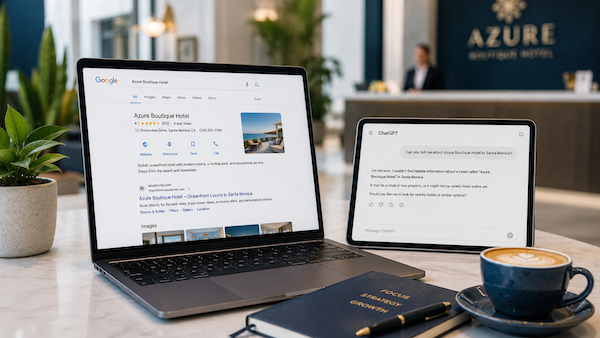
A guest asked ChatGPT for the best boutique hotel in your city last night. It gave three recommendations. Yours was not one of them.
That is not a hypothetical. It is happening now, at scale, to independent hotels across the UK and Europe that have either never properly claimed their map listings or set them up once and left them untouched.
This post covers the three platforms you already have access to and are probably underusing: Google Business Profile, Apple Maps and Bing Places. It also explains why those same profiles now influence whether AI search tools include your hotel in their recommendations, and what to do about it.
The commercial logic is straightforward. A guest who finds you through a map listing and books directly costs you nothing in commission. A guest who finds you through an OTA costs you between 15 and 25% of the booking value. The tools to shift that balance are free. Most hotels simply have not used them properly.
Google Business Profile: the channel most independent hotels have never fully owned.
Google Business Profile is a free tool that controls how your hotel appears in Google Search and Google Maps. It is also one of the most underused direct booking channels in independent hospitality.
When someone searches "boutique hotel near Covent Garden" or "hotel with parking in Edinburgh" on Google, the first thing they see is the Local Pack: three map listings with a photo, a rating, a brief description and, if you have set it up correctly, a direct booking link. 42% of local searchers click on map pack results. Hotels that do not appear there lose nearly half of all potential local search traffic before a guest ever reaches a website.
Relevance and prominence are the two ranking factors entirely within your control. Distance is fixed. Your hotel is where it is. But relevance comes from a complete, accurate and specific profile, and prominence comes from reviews, citations and engagement. Both are things you can improve this week.
What a fully optimised Google Business Profile actually looks like.
Most independent hotel profiles I review in audits are 40 to 60% complete. The information is broadly accurate but incomplete, the photos are outdated, the booking link either points to the wrong page or does not exist, and the profile has not been actively posted to in months.
Here is what complete looks like:
Name, address, phone number and website exactly matching your website and all OTA listings. Any inconsistency across platforms signals unreliability to search engines and costs you local ranking.
Category set correctly. You are not just a "Hotel." Depending on your property you may also be a "Boutique Hotel," "Serviced Apartments," "Wedding Venue" or "Conference Centre." Google allows multiple categories and each one opens up new search queries.
Every amenity attribute completed. Free Wi-Fi, parking, accessible facilities, restaurant, spa, pet-friendly policy. Guests filter by these. If yours are not ticked, you are invisible in filtered searches.
At least 20 high-quality photos, updated within the last six months. Google weighs photo recency. Profiles with recent, professional images consistently outperform those with a static gallery from three years ago.
A direct booking link pointing to your booking engine, not your homepage. Every extra click between a guest and a completed reservation reduces conversion.
Google Posts published at least twice a month. An offer, an event, a seasonal update. Each post appears directly on your profile and gives Google a freshness signal that lifts your local ranking.
The outcome when implemented: properties that optimise and maintain their Google Business Profile actively see measurable improvements in local search visibility within four to six weeks. Review response rates, consistent posting and complete attribute data all contribute to prominence. The booking link directly reduces the friction between discovery and reservation.

YOUR GOOGLE BUSINESS PROFILE STEP BY STEP
Most independent hotels have never fully optimised their Google Business Profile. My guide shows you exactly how to do it.
Apple Maps: the platform OTAs are already on and you probably are not.
Apple Maps reaches hundreds of millions of users through iPhones, iPads, Apple CarPlay, Siri and Apple Watch. When an iPhone user says "find a hotel near me" or asks Siri for a recommendation, Apple Maps is what responds.
Here is the uncomfortable part. Apple Maps already shows your hotel. It pulls content from sources including OTAs and Tripadvisor, which means a guest searching on Apple Maps may see your hotel represented by your OTA profile, not your own. The OTA gets the visibility. You pay the commission.
Apple Business Connect is the free tool that lets you take ownership of that listing. Once claimed and verified, you can control the photos, description, contact details, and critically, add a "Book" action that points directly to your booking engine, bypassing any OTA.
How to claim and optimise your Apple Maps listing.
Go to business.apple.com and sign in with an Apple ID (or create one).
Search for your hotel. If it exists already, claim it. If not, create a new listing.
Complete the verification process (Apple calls the phone number on the listing to confirm ownership).
Upload high-quality images: exterior, lobby, bedrooms, restaurant, outdoor spaces.
Add the "Book" action pointing to your booking engine URL, not a landing page, not the homepage.
Add a "Website" button as a secondary action.
Use the Showcases feature (Apple's equivalent of Google Posts) to publish offers and seasonal updates.
One practical limitation: Apple Maps does not currently support UTM parameters in URLs, which means you cannot directly attribute bookings to the Apple Maps listing in your analytics. The workaround is to monitor direct booking referral traffic from Apple domains and to track website visits from Safari on iOS alongside your booking link click data.
The outcome when implemented: you remove the OTA as the default point of contact for iPhone users finding your hotel. A guest tapping "Book" on your Apple Maps listing lands on your booking engine, not an OTA. That is a direct booking with no commission.
Bing Places: less competition, more visibility for corporate travellers
Bing is the default search engine on Windows devices and Microsoft Edge, which means it is the default for a large proportion of corporate travellers using company laptops and devices. It also powers voice search through Amazon Alexa and underpins Microsoft Copilot, which is now integrated into Office 365 and used by millions of business professionals daily.
The practical advantage for independent hotels is straightforward: fewer properties optimise their Bing Places listings, so there is less competition for visibility. A hotel that does the basic work on Bing often appears prominently for searches where the same effort on Google would produce more modest results.
Bing Places also allows you to import your Google Business Profile directly, which means the setup takes less than an hour if your GBP is already complete. Bing integrates Tripadvisor reviews by default, so your review reputation carries through without any additional setup.
Setting up Bing Places
Go to bingplaces.com and sign in with a Microsoft account.
Use the "Import from Google" option to pull your existing GBP data across. Verify the import is accurate before publishing.
Add any missing information specific to the Bing format: opening hours for ancillary services, parking details, accessibility features.
Respond to reviews where Bing surfaces them. Review engagement is a prominence signal on Bing as it is on Google.
The outcome when implemented: visibility to corporate and business travellers who are less likely to be searching on Google by default, plus incremental reach through Alexa voice search and Microsoft Copilot recommendations, which both draw from Bing's local data.
Why map listings now feed your AI search visibility.
Google Business Profile, Apple Maps and Bing Places were already the most commercially important free channels most independent hotels were underusing. In the past 18 months, they have become something more: foundational inputs to whether AI platforms recommend your hotel at all.
ChatGPT, Perplexity, Claude, Google AI Overviews and Gemini are now answering the question "what is the best boutique hotel in X" with specific named recommendations. Those properties are chosen based on the structured, consistent, credible data those AI platforms can find about each property. Your map profiles are part of that data.
When Google AI Overviews compiles a recommendation for a local hotel query, it draws heavily on GBP data: your category, your attributes, your reviews, your posting history and the consistency of your name, address and phone number across the web. A well-maintained GBP is one of the strongest signals you can send to be included in those AI-generated answers.
Perplexity and ChatGPT extend this further. Perplexity searches the live web in real time and favours properties with a strong, consistent presence across Google, Apple Maps, Bing, Tripadvisor and their own website. ChatGPT draws from training data and live sources, weighting properties with consistent mentions across credible third-party platforms.
A guest does not search your hotel name in ChatGPT. They ask which hotel in your city is best for what they need. Whether you appear in that answer depends on how completely and consistently your hotel is represented across every platform AI can read. Your map listings are where that foundation is built.
The practical implication is this: optimising your Google Business Profile, Apple Maps listing and Bing Places profile is no longer just a local SEO action. It is step one of your AI visibility strategy. The consistency of your data across platforms, the quality of your reviews, the completeness of your attributes and the freshness of your content all contribute to whether AI platforms include you in recommendations or skip you in favour of a competitor with a more complete profile.
Getting your map listings right is the foundation. Understanding the full picture of how AI currently sees your hotel, including structured data, content strategy and third-party authority signals, is a separate, deeper topic.
WANT TO UNDERSTAND YOUR FULL AI VISIBILITY PICTURE?
Map listings are the foundation. But AI visibility goes further: structured data, intent-led content, third-party authority signals. My in-depth guide explains exactly how AI currently sees your hotel, where the gaps are costing you bookings, and the three fixes with the highest commercial impact.
Read: You Rank on Google. But Does ChatGPT Know You Exist?
Reviews: the signal that connects map listings, local SEO and AI all at once.
Reviews deserve their own section because they are the single piece of data that works across every platform covered in this post.
On Google Business Profile, review count and recency are direct ranking signals for the local pack. On Apple Maps, reviews from Yelp and other sources are pulled into the listing. On Bing, Tripadvisor reviews are displayed by default. And on AI platforms, review volume is used as a proxy for credibility: a hotel with hundreds of recent, responded-to reviews is a more reliable recommendation than one with sparse or dated feedback.
The practical work is not complicated. Ask every guest to leave a review on Google at the point in the stay when satisfaction is highest, typically at checkout or in the post-stay email. Respond to every review, positive or negative, within 48 hours. Use your response to a negative review not to defend the hotel but to demonstrate how you handle problems: that is what prospective guests are actually reading.
A hotel in the City of London that I worked with had 180 Google reviews with a 4.2 average and no response history. Within three months of implementing a systematic review request process and responding to every review, they had 340 reviews, a 4.6 average and measurably improved local pack visibility for competitive search terms. No additional spend. Just consistent attention to a free channel.
The detail most hotels miss: NAP consistency across every platform.
NAP stands for Name, Address, Phone number. It sounds simple. In practice, it is one of the most common reasons independent hotels underperform in local search, and one of the most common reasons AI platforms lack the confidence to recommend them.
Every time your hotel name, address or phone number appears differently across platforms, you introduce doubt. "Hotel du Lac" on your website, "Hotel Du Lac" on Google, "Hotel Du Lac Edinburgh" on Booking and "The Hotel du Lac" on Tripadvisor are four variations of the same property. Search engines and AI platforms see inconsistency as a reliability signal. It reduces your local ranking and reduces your chances of AI citation.
The fix is methodical rather than technical. Audit every platform where your hotel is listed: Google, Apple Maps, Bing Places, Tripadvisor, Booking, Expedia, your own website, any local directories. Standardise the exact format of your hotel name, full address and phone number across all of them. Do not abbreviate. Do not vary punctuation. The same string, everywhere.
This is not glamorous work. It is also not optional if local search and AI visibility matter to your commercial performance.
These are not "set and forget" channels.
The reason most independent hotels underperform on Google Maps, Apple Maps and Bing is not that they have not heard of these platforms. It is that they were set up once, years ago, and have not been actively managed since.
Google Business Profile rewards activity. Recent photos, regular posts, consistent review responses and updated information all contribute to local ranking. A profile left static for six months will progressively lose ground to competitors who are actively managing theirs. The algorithm treats inactivity as a signal that the business is less relevant.
The same principle applies to AI search. AI platforms prioritise properties with consistent, current, credible data across multiple sources. A hotel that actively maintains its map profiles, builds review volume and publishes useful content is the hotel that gets cited in AI recommendations. The hotel that optimised once in 2022 and has not touched it since is the one that does not appear.
None of this requires agency budget or technical expertise. It requires 30 to 60 minutes a month of consistent attention to channels you already own.
If you want to know where your hotel currently stands across all of these: what is complete, what is missing, what is costing you bookings and what to fix first. That is precisely what the Visibility Audit covers.
READY TO TALK ABOUT YOUR HOTEL SPECIFICALLY?
Book a free 30-minute call and tell me about your property. I will give you an honest view of where your biggest visibility gaps are and whether I am the right person to help you act on them.
FAQs: hotel map listings, local SEO and AI search visibility.
-
Google AI Overviews draws directly from Google Business Profile data when responding to local hotel queries. Your category, attributes, review history, posting frequency and NAP consistency all influence whether AI Overviews includes your property in a recommendation. A complete, actively maintained GBP is one of the strongest foundational signals you can send. Perplexity and ChatGPT also weight properties with strong, consistent presence across Google, Apple Maps and Tripadvisor. For a deeper dive into how AI platforms assess your hotel beyond map listings, see the companion post: /blog/ai-visibility-breakdown
-
Google Business Profile is free and controls how your hotel appears in Google Maps and local search results. Google Hotel Ads is a paid channel that allows you to advertise your direct rate in Google's hotel booking panel. They are separate products but complementary: a strong GBP improves your organic local visibility, while Hotel Ads can amplify that with paid placement. Most independent hotels should focus on optimising their GBP fully before investing in Hotel Ads.
-
Yes, for two reasons. First, iPhone users represent a significant share of travellers across the UK and Europe, and Siri and Apple Maps are the default navigation and search tools on those devices. Second, Apple Maps is increasingly used as a source by AI platforms including Perplexity when compiling local recommendations. A hotel absent from Apple Maps is a hotel invisible to a meaningful portion of the market, regardless of how well it performs on Google.
-
Google Business Profile responds best to regular activity: publishing posts at least twice a month, responding to reviews within 48 hours, and updating photos seasonally. Apple Maps and Bing Places are less frequency-dependent but should be audited quarterly to ensure accuracy and that any new amenities, services or offers are reflected. The minimum that maintains performance is a monthly check of all three platforms.
-
NAP stands for Name, Address, Phone number. Search engines and AI platforms cross-reference your hotel's data across every platform where it appears: your website, Google, Apple Maps, Bing, OTAs, directories and review sites. Any inconsistency in how your hotel name, address or phone number is formatted creates a reliability signal that reduces your local ranking and your AI citation potential. Auditing and standardising your NAP across all platforms is one of the highest-impact, lowest-cost local SEO actions an independent hotel can take.
-
Yes, and you should. Both Google Business Profile and Apple Business Connect allow you to add a direct booking link. Set this to point to your booking engine's landing page for your property, not your homepage. Every extra click between a guest seeing your map listing and completing a booking reduces conversion. A direct link to the booking engine removes that friction and keeps the guest on your direct channel rather than routing them through an OTA.
-
Yes, particularly for properties targeting business travellers or guests travelling on Windows devices. Bing is the default search engine on Microsoft Edge and Windows, and Bing data powers Amazon Alexa and Microsoft Copilot recommendations. The setup takes less than an hour if you use the Google Business Profile import function. The competitive advantage is real: fewer independent hotels optimise their Bing listings, which means less competition for visibility with a specific and commercially valuable audience.
-
Not necessarily. Google rankings and AI visibility are related but not the same thing. AI platforms synthesise data from multiple sources and apply their own weighting, which means a hotel can rank strongly on Google and still be largely absent from ChatGPT, Perplexity or Google AI Overviews. Map listing optimisation is the foundation, but there are additional signals — structured data, content strategy, third-party authority — that determine your full AI visibility. The companion post covers exactly this: /blog/ai-visibility-breakdown].