Most independent hotels have a Google Business Profile. Most of them claimed it at some point, added basic information, uploaded a handful of photos, and then left it largely untouched. It sits there as a listing, showing the address, the phone number, and whatever the opening hours were when someone last thought to check.
Meanwhile, Booking and Expedia are updating their Google presence daily. Their listings are complete, their photos are current, their reviews are responded to within hours, and their rate comparison modules feed directly into the Google search results page at the exact moment a potential guest is deciding where to stay.
Your Google Business Profile is one of the few genuinely free tools available to an independent hotel that can compete at that moment of decision. It reaches guests who are searching with intent. It feeds directly into the local map pack, Google Maps, Google Hotel Search, and increasingly into AI-generated answers when someone asks an AI tool where to stay in your area. And for most independent hotels, it is significantly underused.
What the Profile Actually Does for Your Hotel.
It is worth being precise about what a Google Business Profile does, because the role it plays has expanded considerably in the last two years.
At the most basic level, the profile controls what Google shows when someone searches for the hotel by name. The knowledge panel that appears on the right side of the search results, or prominently on mobile, draws its information directly from the profile: name, address, phone number, website, photos, opening hours, star rating, and reviews. If any of these are incorrect, out of date, or missing, that is what guests see at the moment they are deciding whether to enquire or book.
At a more sophisticated level, the profile determines whether the hotel appears in the local map pack when guests search for accommodation in the area without necessarily knowing the property name. Searches like "boutique hotel near Edinburgh city centre" or "serviced apartment Manchester with parking" trigger the local map pack, which shows three or four properties on a map with their ratings, price indicators, and key details. Appearing in that pack is one of the most commercially valuable positions in local search, and it is determined primarily by the completeness, accuracy, and activity level of the Google Business Profile.
In 2026, there is a third dimension that matters increasingly: the profile feeds AI search. When a guest asks Google's AI Mode, ChatGPT connected to Bing, or Perplexity where to stay in a given area, these systems draw from the same data sources as traditional search, with Google Business Profile data being one of the primary inputs for local property recommendations. A hotel with a complete, active, well-reviewed profile is materially more likely to be cited in an AI-generated answer than one with a sparse or inactive listing. As I covered in the maps and AI search article, this connection between GBP activity and AI visibility is not theoretical. It is the operational reality of how AI tools retrieve local property data today.
What Most Hotels Are Getting Wrong.
The most common GBP failures for independent hotels are not complicated. They are consistent.
The primary category is wrong or incomplete. Google Business Profile requires the hotel to select a primary category that tells Google what type of business it is. Many hotels are categorised simply as "hotel" when more specific categories are available and more accurately describe the property: "boutique hotel," "serviced apartment," "aparthotel," or "extended stay hotel." The category selection directly affects which searches the profile appears in, and a vague or incorrect primary category means the hotel is invisible in the searches most relevant to its actual product.
Photos are outdated or insufficient. Google favours profiles with a high volume of recent, high-quality photos across all categories: exterior, rooms, dining, facilities, and local area. Profiles with fewer than twenty photos in each relevant category are leaving visibility on the table. More importantly, the most recently added photos carry more weight in the ranking signal than older ones. A hotel that uploaded fifty photos two years ago and has added nothing since is telling Google that the property is not actively managed.
Posts are absent. Google Business Profile allows the hotel to publish posts, short updates visible on the profile, covering offers, events, news, and seasonal content. Each post is indexed by Google as a fresh content signal. A hotel publishing weekly posts is consistently outperforming an inactive profile in local ranking, because posting signals to Google that the business is engaged and current. This takes around thirty minutes per week. The return on that investment in local visibility is disproportionate to the effort.
Review responses are missing or generic. Google reviews are one of the most powerful signals in the local ranking algorithm, and responding to them matters both for ranking and for the impression made on potential guests who read the reviews before booking. A response that acknowledges the specific stay, thanks the guest by name where appropriate, and addresses any concern honestly is doing more commercial work than a template "thank you for your feedback" reply. As I covered in the reviews article, reviews are also one of the primary data sources that AI tools use when generating property recommendations. A well-managed review response history is, in part, AI content optimisation.
Questions and answers are unmanaged. The GBP allows guests to ask questions publicly, which appear on the profile for all subsequent visitors to read. These questions sit there unanswered, or are answered by other guests with information that may be inaccurate. Proactively seeding the Q&A section with the questions guests most commonly ask, and answering them accurately and completely, is both a guest experience improvement and a local SEO signal.
The Direct Booking Connection.
Here is the commercial argument that turns GBP from a maintenance task into a strategic priority.
A guest who finds the hotel through a generic area search on Google, sees it in the local map pack with a strong rating and recent photos, clicks through to the profile, and finds a clear direct booking link is a guest who has arrived at the hotel's own booking engine without passing through an OTA. The GBP profile page itself includes a "Book" button that can be linked directly to the booking engine. If that button is not set up, the guest defaults to whatever booking option is most prominent, which is often the OTA link that appears elsewhere on the page.
The booking link setup is a five-minute task. A significant proportion of independent hotels have not done it.
The profile also connects to Google Hotel Ads and free booking links through the same connectivity that powers the rate comparison module in hotel search results, as covered in the Google Hotel Ads article. An active, well-optimised GBP is the foundation on which that connectivity rests. Without it, the free booking link cannot display the direct rate correctly, and the hotel is invisible in the price comparison at exactly the moment when a guest is choosing where to book.
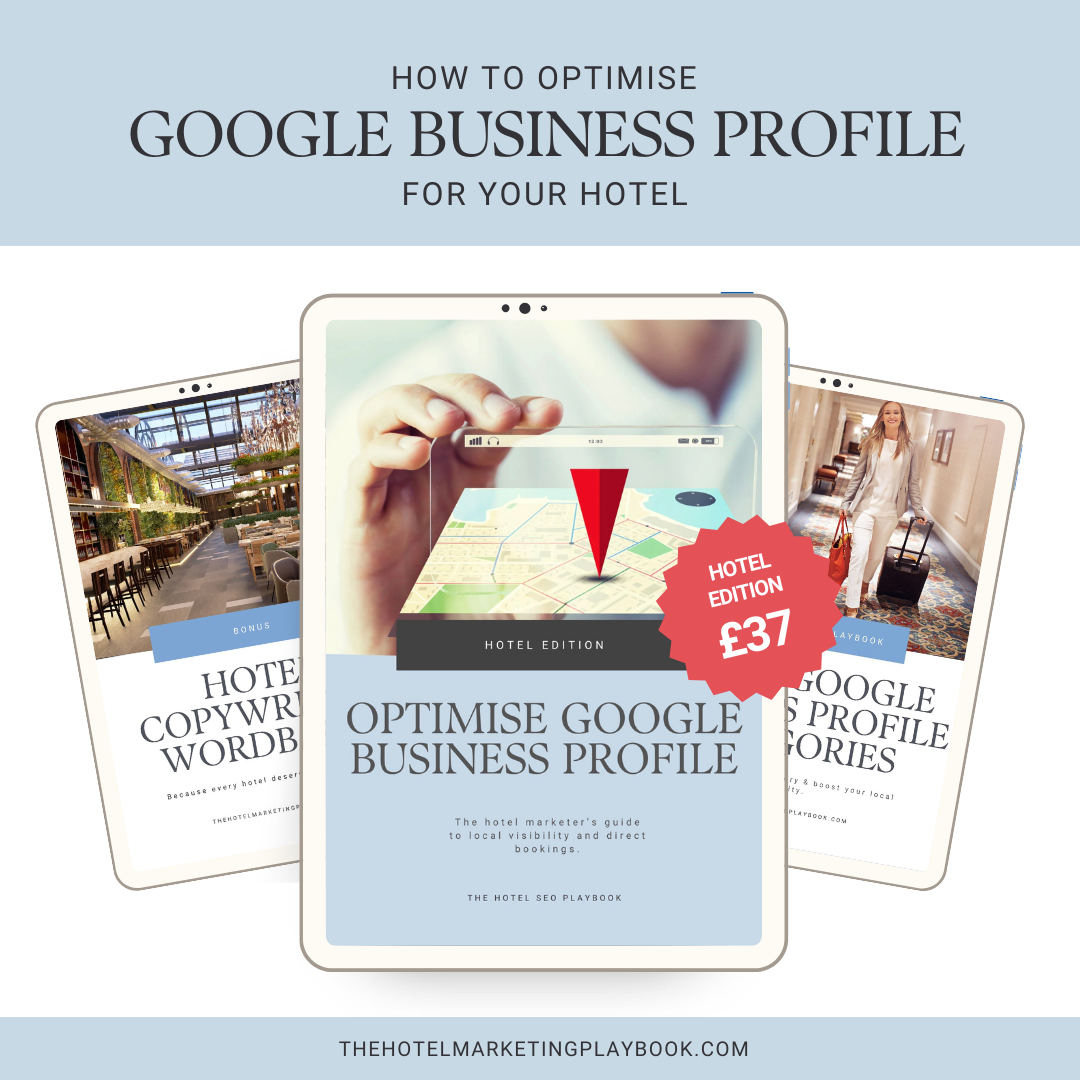
GOOGLE BUSINESS PROFILE
Learn how to manage your Google Business Profile.
CLICK TO GET YOUR COPY
What Good GBP Management Looks Like in Practice.
This is a weekly discipline, not a one-off setup. The hotels that consistently rank in the local map pack and appear in AI-generated recommendations are the ones treating the GBP as an active channel rather than a static listing.
The baseline that needs to be correct and kept current: business name exactly matching all other online listings, address and phone number consistent across every platform, website URL pointing to the direct booking page or homepage, correct primary and secondary categories, complete list of amenities and facilities using every relevant attribute Google offers, and hours of operation current and accurate.
The weekly activity that sustains and improves ranking: one post per week covering a seasonal offer, a local event, a property update, or genuinely useful destination content. This does not need to be long. A short paragraph with a relevant image is sufficient. The consistency matters more than the length.
Photo uploads on a rolling basis: add new photos regularly rather than in bulk once a year. Aim to have recent photos across every category that Google offers: exterior, lobby, rooms, bathrooms, restaurant, spa, pool, local area. Rotate seasonal photography so the profile reflects the property as it currently looks.
Review management weekly: respond to every new review within 48 hours, positive or negative, in a voice that matches the property's brand. Read each review for operational intelligence as well as for the response opportunity.
Q&A monitoring monthly: check for new questions and answer them promptly. Review the existing Q&A section and add any high-value questions that guests frequently ask at check-in or by phone.
Insights review monthly: the GBP provides data on how many people found the profile, how they searched for it, what actions they took, and how the photos are performing. This data is genuinely useful for understanding local search performance and identifying gaps.
The AI Visibility Layer.
The connection between GBP and AI search is the newest and arguably the most commercially significant development in this space.
When a guest asks Google's AI Mode "good boutique hotels near the Royal Mile in Edinburgh," the AI draws on GBP data as a primary source for local property information: the name, category, rating, reviews, amenities, and location all feed into what the AI surfaces. According to one analysis, 79% of Google AI Mode hotel link clicks route to a Google Business Profile, which means the GBP is not just a discovery tool but the destination that captures the booking intent generated by AI search.
This makes GBP optimisation one of the highest-return activities in hotel digital marketing in 2026, because it simultaneously serves traditional search, local map visibility, Google Hotel Search, and AI discovery through a single, free, owned asset. The properties that will be cited in AI-generated hotel recommendations a year from now are the ones building that asset properly today.
If you want to know whether the current GBP setup is working correctly, whether the booking link is configured, and where the gaps are in local visibility, the Hotel Visibility Audit covers the Google Business Profile as one of its eight assessment areas, alongside the website, OTA listings, paid media, and SEO. For ongoing management of the profile as part of a broader direct booking programme, the Embedded Marketing Partner includes this as a standing workstream, handled consistently every week without it falling off the priority list.
FAQs About How to Use Google Business Profile For Hotels.
-
Start with the fundamentals: ensure the business name, address, phone number, and website URL are correct and consistent with every other platform the hotel is listed on. Set the correct primary category, complete every available attribute and amenity field, and set up the direct booking link button on the profile. Then establish a weekly rhythm: one post per week, new photos added regularly, and every review responded to within 48 hours. These activities take two to three hours per week and consistently outperform inactive profiles in local search ranking and AI visibility.
-
Yes, significantly. Google's AI Mode, ChatGPT when connected to Bing, and other AI tools use local business profile data as a primary source when generating accommodation recommendations. A complete, active GBP with strong reviews, accurate amenity information, and consistent data across all platforms is materially more likely to be cited in an AI-generated answer than a sparse or inactive listing. In 2026, GBP optimisation is one of the most effective actions an independent hotel can take to improve AI search visibility at no cost.
-
Once per week is the minimum that produces a measurable local ranking benefit. Each post is indexed by Google as a fresh content signal and contributes to the activity level that the local ranking algorithm rewards. The content can be straightforward: a seasonal offer, a local event, a new menu item, a package, or a destination tip. The consistency matters more than the complexity of the content. A hotel that posts weekly for six months will consistently outrank an inactive competitor profile, all else being equal.
-
If only one thing can be fixed first, it is accuracy and consistency: ensuring the business name, address, phone number, and website URL exactly match what appears on the hotel's own website and on every OTA and directory listing. Inconsistency in these details reduces Google's confidence in the listing and suppresses local ranking. The second most impactful fix is setting up the direct booking link, which routes guests from the GBP directly to the booking engine without going through an OTA. This is a five-minute task that many hotels have not completed.