Funnel vs Flywheel in Hotel Marketing: The Bridge Moment Most Hotels Skip.
Guests do not move through a neat, predictable path anymore. They browse, compare across several tabs, scroll past a hotel three times before finally clicking through, and then sometimes still book somewhere else entirely. Trying to manage that behaviour with a single linear model, awareness leading tidily to consideration leading tidily to a booking, was never a fully accurate picture, and it is even less so now. Most independent hotels still run their marketing as if it were, which is why so many keep paying full acquisition cost for the same guest, over and over, who would have happily booked direct a second and third time if anyone had actually built the relationship after checkout.
This pattern is easy to miss from the inside, because each individual booking looks perfectly healthy on its own. A guest finds the hotel, books, stays, leaves. The problem only becomes visible when you zoom out and notice that the property is spending roughly the same amount, proportionally, to win each new booking month after month, regardless of how many genuinely happy guests have already stayed there. That flat acquisition cost over time is usually the clearest signal that a hotel is running a funnel with no flywheel attached to it.
This is where the funnel and the flywheel both matter, not as competing theories but as two different jobs that need to be done well, in sequence, for a hotel's marketing to compound rather than restart from zero every single month.
What the funnel is actually good at.
The funnel, developed well over a century ago and still genuinely useful, describes the path from a stranger's first awareness of a hotel through to the moment they book. It is wide at the top, where paid advertising, social content and SEO bring a large pool of potential guests into view, and narrow at the bottom, where only a fraction actually convert into a reservation. This model is fast. It generates bookings whenever you spend, which makes it the obvious tool for filling rooms next week, launching a new property, or recovering from a quiet patch in the calendar.
The honest limitation is that the funnel restarts every cycle. It pours new awareness in at the top and produces bookings at the bottom, but it has no built-in mechanism for capturing what happens after that booking. A guest converts, checks out, and the next booking has to be won entirely from scratch again, at full acquisition cost, through paid traffic, OTA commission, or another promotional push. For a hotel relying purely on the funnel, marketing never gets cheaper or easier over time. It stays exactly as expensive as the day the property opened.
What the flywheel adds, and why it cannot work alone either.
The flywheel reframes the guest not as a destination at the bottom of a funnel but as a growth asset in their own right. It is a continuous loop: a guest's stay, if it is genuinely good, produces a review, a referral, and a guest who is meaningfully more likely to book directly next time, at a lower acquisition cost than the first visit cost to win. Each of those outcomes feeds back into attracting the next guest, which is the mechanism the funnel simply does not have. This is the flywheel's real value for a hotel specifically, an industry where reputation and word of mouth are unusually powerful drivers of new business compared with many other categories.
But a flywheel needs fuel to start spinning in the first place. A new hotel, or one that has not invested in visibility for some time, has no guest base yet to delight, refer or retain. Trying to run a flywheel-only strategy without first generating real volume through the funnel is asking a wheel to spin with no force applied to it at all. The two models are not rivals competing for budget. They are sequential parts of the same engine, and treating either one as sufficient on its own leaves a hotel with either a pipeline that has no retention engine or a retention engine with no reliable way to fill it.

The bridge is the part almost every hotel skips.
This is the genuinely underused piece. Between the funnel converting a stranger into a guest and the flywheel turning that guest into an advocate sits a short, specific window, the period immediately after booking through to checkout, that determines whether the flywheel ever actually starts turning. Most hotels treat this window as purely operational, the booking confirmation, the stay itself, check-out, with marketing picking back up only once the next campaign needs to launch. That gap is where a huge amount of potential momentum quietly disappears.
A guest captured through the funnel and properly bridged into the flywheel gets a thoughtful pre-arrival journey, not just a transactional confirmation email, building genuine anticipation and capturing consented contact details for future use. They get a stay genuinely designed to produce something worth sharing, memorable, personal, the kind of detail a guest naturally wants to tell people about rather than something engineered purely for a photo. And critically, they get a deliberate post-stay sequence: a request for a review, a referral incentive, and a bounce-back offer that gives them a specific, time-bound reason to return rather than a vague hope that they remember the property fondly months later.
Make the post-stay sequence non-negotiable.
This is the single highest-leverage starting point for a hotel that currently has no flywheel mechanism running at all. Every guest should receive a thank-you message that does three things at once: asks for a review with a direct link, which connects to the wider case made in turning reviews into revenue, where reviews function as far more than reputation management, offers a referral incentive that turns a satisfied guest into an active recruiter rather than a passive fan, and includes a bounce-back offer giving them a specific, attractive reason to book again within a defined window rather than leaving the timing entirely to chance.
This single sequence, set up once and then running automatically, is an easy, low-effort win that keeps a guest in the hotel's orbit well beyond the stay itself. Properly captured and segmented contact details from this moment also become the foundation of an ongoing email programme, which is precisely the infrastructure that lets a flywheel keep spinning between stays rather than only at the moment of a single follow-up message.
Use each model deliberately, not interchangeably.
The practical guidance is straightforward once the distinction is clear: use the funnel when the priority is quick results, filling specific dates, launching a new offer, recovering occupancy in a soft period. Use the flywheel to keep existing guests returning and turn them into the marketing engine that makes future funnel activity less necessary. The smartest hotel marketers do not choose one over the other. They use the funnel to generate initial momentum and the flywheel to compound it over time, which is also where the wider distinction between brand-focused and performance focused marketing roles becomes relevant, since the funnel tends to sit more naturally with performance marketing discipline, while the flywheel depends heavily on the kind of guest experience and storytelling work that sits with brand marketing.
Why this should be designed into the plan, not improvised stay by stay.
A bridge sequence improvised inconsistently, sometimes sent, sometimes forgotten depending on who happens to be covering reception that week, does not produce a reliable flywheel. It produces an occasional lucky review and not much else. This needs to be built deliberately into the wider marketing plan as a defined, automated workflow with a named owner, reviewed and refined on the same quarterly cycle as everything else, rather than left to individual initiative or memory. Treating it as a side project that someone will get to eventually is the most common reason flywheels never start turning in the first place, regardless of how much budget continues to go into the funnel feeding them.
It is also worth tracking the compounding effect deliberately rather than assuming it is happening. Direct booking percentage from repeat guests, referral volume, and the proportion of bookings coming from the hotel's own database rather than paid acquisition are the numbers that tell you whether the flywheel is genuinely turning. A hotel where these figures are flat or declining despite a healthy funnel is a hotel where guests are being acquired well but not retained, which means every single booking continues to cost full acquisition price indefinitely, regardless of how strong the top of the funnel looks on paper.
The connection back to OTA dependency.
This entire conversation connects directly to the wider relationship a hotel has with OTAs. As covered in the Marmite relationship hotels have with OTAs, reducing OTA dependency is rarely about a single dramatic shift. It is the cumulative effect of converting OTA-sourced first-time guests into direct, flywheel-driven repeat guests over time. A guest who books their first stay through Booking and then, because the bridge and flywheel were properly built, returns directly six months later, represents exactly the kind of margin recovery that compounds far more reliably than any single campaign ever could.
If your hotel currently has a strong, well-funded funnel but no deliberate bridge or flywheel mechanism running afterward, that gap is one of the more cost-effective fixes available, since it requires building a system once rather than continuously increasing paid spend. The return on fixing this tends to show up gradually rather than immediately, which is also why it gets deprioritised in favour of more visible, faster-feeling activity. A bounce-back offer sent today will not produce a booking tomorrow. It will produce one in three or six months, quietly, at a fraction of what that same booking would have cost to win from scratch through paid acquisition, and that delayed but compounding return is precisely what makes the flywheel worth building properly rather than leaving to chance.
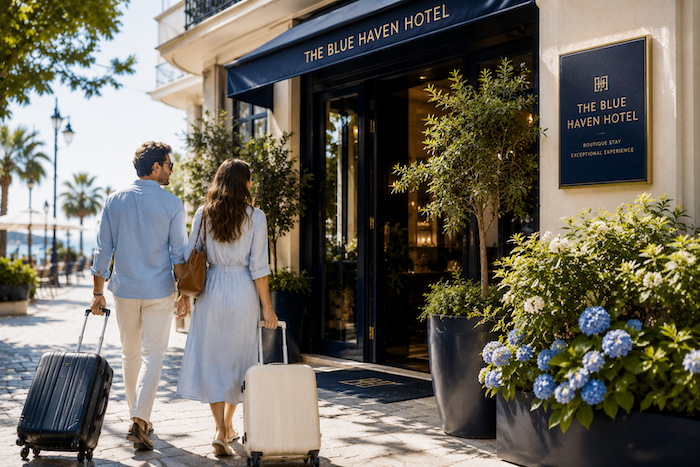
A Hotel Visibility Audit reviews the full guest journey, including this post-stay infrastructure, as part of its assessment, with a clear, prioritised set of fixes delivered within two to three weeks.
Frequently Asked Questions on Funnel and Flywheel For Hotel Marketing.
-
The funnel almost always comes first, since a flywheel needs an existing base of guests to delight, refer and retain, and a new or under-visible property has no such base yet. Once the funnel is generating consistent booking volume, building the bridge and flywheel mechanisms becomes the priority, since they are what stop every future booking costing the same as the first one.
-
The bridge is the period immediately after a guest books through to checkout, the pre-arrival journey, the stay itself, and the post-stay follow-up. This is where a hotel either captures the momentum generated by the funnel and turns it into a lasting relationship, or lets it dissipate by treating the stay as purely operational and marketing as something that only resumes once the next campaign launches.
-
At minimum, a personalised thank-you message with a direct review request, a referral incentive, and a bounce-back offer giving the guest a specific, time-bound reason to return. This sequence, properly automated, is one of the most cost-effective pieces of marketing infrastructure a hotel can build, since it requires setting up once and then runs continuously without ongoing paid spend.
-
Track direct booking percentage from repeat guests, referral volume, and the share of total bookings coming from the hotel's own guest database rather than paid acquisition or OTAs. If these figures are flat or declining despite a healthy, well-funded top-of-funnel marketing effort, the hotel is acquiring guests well but failing to retain them, meaning every booking continues to cost the same as the very first one.